Showing posts with label A-Z April 2013 Challenge. Show all posts

Tuesday, 30 April 2013

Zooming Around!

In September 2002, a friend and I decided to 'zoom around' i.e. complete a sponsored ‘Castle Trail’ to raise funds for a new building on our Girl Guide campsite. The site was called Ashley, and the mascot was a rabbit, so of course we had to take ‘Ashley the Rabbit’ on our trail. Our aim was to visit 15 castles in a 12-hour period.

'Ashley' at Sandal Castle, Wakefield
We planned the route carefully and set off at 7.30am, heading from Manchester over the Pennines into Yorkshire. We were held up by traffic jams near Leeds, and by roadworks outside Wakefield, and so we were half an hour behind schedule when we arrived at Sandal Castle, just outside Wakefield. Time for a quick photo, and we were off again, to take Ashley's photo at Pontefract, Spofforth, and Knaresborough. At the latter, we attracted some curious glances as we had to park on the main street because there was no place to park near the castle. People must have wondered what we were doing carrying a large rabbit with us!

Middleham
The next castle, Ripley, was closed, but we took a photo near the main gate. Then it was north again to Middleham, and a quick break for a soup and sandwich lunch at the Richard III pub in the main square. By this time we had done 128 miles and it was 12.15pm.

On again to Richmond Castle in North Yorkshire, and then into County Durham to visit Raby Castle, the home of the Neville family (and the birthplace of Richard III’s mother, Cecily Neville), Barnard Castle and Bowes Castle.

We then headed west into Cumbria, stopping at Brough, Appleby, and Brougham castles (which had all belonged to the Lancastrian Clifford family - boo, hiss!). Our final stop in Cumbria was at Penrith Castle, where a little girl in the park surrounding the castle was very excited at seeing our large rabbit!

We changed our plans slightly at this stage, as we’d intended stopping at Kendal Castle, but that involved quite a long detour off the motorway, so we continued south to Lancaster Castle, which we finally reached after going around the one-way system twice, and also ending up in the bus station at one point.

Last stop at Clitheroe
We still had some time left, so although Lancaster was our 15th castle, we decided to take a detour to Clitheroe. All went well until we reached the country lane leading to the town when we got behind one of the ‘Isn’t it a lovely evening? Let’s go for a drive’ drivers, who went about 20 miles an hour. However, we made it to Clitheroe for about 6.30pm, and finally got home at 7.25pm, just within our deadline, and after a 329 mile round trip!


Our route

Many thanks to you all for joining me on this A-Z tour
of 15th century England.
Look forward to seeing you here again,
hopefully sometime before next year's April A-Z Challenge!


Monday, 29 April 2013

York


Founded by the Romans in the 1st century A.D, the city of York has a rich heritage covering every period of history ever since then.
 
In the early Middle Ages, it was the capital of the kingdom of Northumbria, and in the 9th century, it was captured by the Vikings.
 
York Minster, the city’s most well-known edifice, was founded in the 7th century, but the current building dates from the 11th century. It is a beautiful church, and has been completely restored after the disastrous fire in the 1980s. The Rose Window, with its red and white roses, was added at the end of the 15th century  to commemorate the union of the houses of York and Lancaster when Henry Tudor married Elizabeth of York. After the fire, the 7,000 pieces of stained glass had cracked into about 40,000 pieces. Craftsmen took about four years to restore the window to its former glory.
 
It was also interesting to see the memorial window to Richard III, installed by the RIII Society in 1997.
 
The chapel of the medieval Archbishop’s Palace still exists, and it was here that Richard created his son Edward as Prince of Wales in 1483.
 
Substantial remains of the city walls still exist, as do the gates into the city, knows as ‘Bars’. The four main ones were Bootham Bar, Monk Bar, Micklegate Bar and Walmgate Bar. After the battle of Wakefield in 1460, the heads of Richard of York and his son Edmund were displayed on spikes on Micklegate Bar, adorned with paper crowns.
 
In 1472 Edward IV set up the Council of the North, and appointed his brother Richard as its first President. Thus Richard virtually ruled the north on behalf of Edward, and he was highly regarded by the people there, and especially by the City of York. The city archives contain this record, dated 23 August 1485 (the day after the Battle of Bosworth): King Richard, late mercifully reigning upon us … was piteously slain and murdered, to the great heaviness of this city.
 
It seems Richard intended to be buried at York Minster and planned to build a large chantry chapel there for priests to pray for his soul. Definitely a moot point now that his body has been found in Leicester, and plans are underway for him to be buried at Leicester Cathedral. 

Saturday, 27 April 2013

X marks the spot - or does it?


The ‘Bloody Tower’ in the Tower of London is ‘traditionally’ the place where the two princes, Edward and Richard, sons of Edward IV, were reputed to have been murdered by, or on the order of, their ‘wicked’ uncle, Richard III.
 
In the 15th century, it was known as the Garden Tower, because it overlooked the gardens of the Lieutenant’s lodging in the Tower (now called the Queen’s House). It’s worth noting that the Tower at this time was a royal residence, and a contemporary French chronicler mention the boys playing and practising archery in the garden in the summer of 1483.
 
Nothing more was seen or heard of them but this doesn't necessarily mean they had been killed. Reams have been written about them, including the theory that they had been taken elsewhere for safety, possibly in Flanders, but I don’t intend to go into all this now.
 
The first ‘evidence’ came during the reign of Henry VII who defeated and killed Richard at the battle of Bosworth in 1485. One of Richard's knights, Sir James Tyrrell, ‘confessed’ (under torture) that he ) had killed the princes, with the assistance of two others, but was unable to say where their bodies were. However, there is no evidence that Tyrell's alleged co-murderers were ever interrogated, and Tyrell was not charged with regicide.

Thomas More, who gives the most detailed account of the supposed murder, says the bodies were first buried 'at the stayre foot, metely depe in the ground under a great heape of stones' and then moved to a 'better' site 'because thei were a kinges sonnes'. The priest who reburied them had died by this time, and so no one knew where the bodies were buried. How very convenient!
 

In 1674 (i.e. nearly 200 years later) workmen demolishing a stone staircase connecting the royal apartments with the White Tower, found bones in a wooden chest, about “ten feet in the ground”. This has been taken to mean they were found under the stairs, rather than ten feet further down. It was decreed that the bones were those of the two princes, and King Charles II commissioned a marble casket for them which still stands in Westminster Abbey.
 
The whole story seems to have more holes than a sieve! More says the princes were buried at the stair foot, and then moved to a ‘better site’ and the information board at the Tower reiterates this. It says the bodies were buried for 24 hours under the stairway leading to the Wakefield Tower which adjoins the Bloody Tower, and were then removed by a priest and buried under an exterior staircase leading to the White Tower. One wonders how that could possibly be called a ‘better site’? And pity the poor priest who supposedly dug up the bones from under one staircase - and promptly buried them under another! At the time, probably dozens, if not hundreds, of people lived in the Tower of London. So no one saw a priest digging under a couple of staircases and asked questions? Add to that the fact that, if (and this is a big 'if') the princes had been murdered, it would have been far easier to take the bodies through the gate very near the Bloody Tower which led to steps down to the River Thames, from which a boat could take them and dump them out at sea.
 
In 1933, experts were allowed to examine the bones in the casket, but scientific knowledge at that time was scanty at best, and concentrated mainly on dental evidence, much of which has now been discredited.

However, until the royal family allow further examination of the bones, with modern methods of dating etc, there is no way of proving whether or not the bones in the casket are really the bones of the princes. And even if they are, there is still no proof that Richard III killed them. There were others with far greater motives for wanting the princes dead.
The memorial in Westminster Abbey,
supposedly containing the bones of the Princes
 
 
P.S. For true Ricardians, I apologise for this much abridged version of ‘ what happened to the princes?’ I’m well aware it is far more complex than my basic summary here!

Friday, 19 April 2013

Queen Elizabeth Woodville


Elizabeth Woodville, Edward IV’s Queen, played a pivotal role in many of the events of the later 15th century.

She was born about 1437 at Grafton Regis in Northamptonshire, and in about 1452 married Sir John Grey of Groby in Leicestershire. He was killed, fighting for the Lancastrian side, at the 2nd battle of St Albans in 146i and , leaving her with two sons from this marriage, Thomas, later Marquess of Dorset, and Richard Grey, who were deprived of their inheritance.

Tradition says that when Elizabeth discovered Edward IV was hunting in Northamptonshire, she waited for him, with her two young sons in each hand, under an oak tree, known afterwards as ‘the queen’s oak’. When he passed by, she threw herself at his feet and pleaded with him for the restoration of her sons’ inheritance.

Edward was evidently besotted by the young widow, who was said to be ‘the most beautiful woman in England.’ Their courtship took place in secret and so did their marriage, which, again according to tradition, took place at Grafton Regis on May 1st, 1464.


In the meantime, Richard Neville, Earl of Warwick, had been negotiating an alliance with France to thwart a similar effort also being made by Margaret of Anjou, wife of Henry VI. The alliance was to be sealed by the marriage of Edward to a French princess so, when Warwick heard of the king’s clandestine marriage, he was not unnaturally furious. It caused the rift between himself and the king that culminated in his death at the battle of Barnet.

Once Edward was re-established on the throne, his queen lost no time in securing advantageous marriages for her many siblings, including her youngest brother John aged 20 to the three-times widowed Duchess of Norfolk who was in her sixties.

She gave Edward three sons and seven daughters between 1466 and 1480, although two of these died as infants. When Edward IV died in 1483, the attempt by Elizabeth and her kin to gain power through controlling the new, young King Edward V was pre-empted by Richard, Duke of Gloucester. Her brother and oldest son were both arrested and later executed, and Elizabeth was accused by Richard of plotting to ‘murder and destroy him.’

She fled into sanctuary at Westminster with her children, but then allowed her youngest son to join his brother in the Tower of London. Less than a year later, she came out of sanctuary and returned to court, apparently reconciled with Richard. One can’t help but winder whether she would have done this if she believed Richard had murdered her two young sons.


However, she did form an alliance with Margaret Beaufort, mother of Henry Tudor, and an agreement was made that Henry would marry her eldest daughter once he gained the throne. Thus Elizabeth of York married the Lancastrian Henry Tudor in January 1486, uniting the houses of York and Lancaster. The white rose of York was mixed with the red rose of Lancaster to form the Tudor rose.

About the same time, Elizabeth Woodville entered Bermondsey Abbey, although it is not clear whether this was her own wish, or whether Henry VII forced her to retire from court. She died in June 1492 and her funeral was a small simple one, with the result that one contemporary source criticises Henry VII for not arranging a more queenly funeral for his mother-in-law. She was buried with Edward IV at St George’s Chapel, Windsor.
Edward IV's tomb at Windsor


Thursday, 18 April 2013

Pontefract Castle


Pontefract is a small town in West Yorkshire – and our visit there was fraught with problems, namely some incomprehensible parking rules in the town centre, kamikaze pedestrians who thought nothing of stepping into the road in front of your car, confusing signs to the castle, and a closed Visitor Centre when we finally got there!


The castle itself was a little disappointing too. This painting from the early 17th century shows a magnificent structure, but the castle, a Royalist stronghold, was destroyed by the Parliamentarians in 1644 (during the English Civil War) and only the ruins remain.

It was first built by Ilbert de Lacy about 1070, having been granted the land by William the Conqueor in return for his support. The first castle would have been a wooden structure on a man-made ‘motte’ and was replaced by a stone keep, and other buildings around an inner courtyard (or bailey).

The ruins of the keep
In 1311 it passed by marriage to the estates of the house of Lancaster, and later in the century, John of Gaunt, as Duke of Lancaster, made it his personal residence and spent a lot of money improving it.

When his son, Henry Bolingbroke, usurped the throne in 1399, Pontefract became one of the main royal residences in the north of England. Henry’s predecessor, the deposed Richard II, was murdered there, traditionally thought to be in the Gascoigne Tower. Although Shakespeare says he was hacked to death, it seems more probable that he was actually starved to death.

During the early part of the Wars of the Roses, the castle was a Lancastrian stronghold. Their forces came from Pontefract to the battle of Wakefield in 1460, and one of the Yorkist leaders, Salisbury, was executed there after the battle. The bodies of Richard, Duke of York, and his son were also buried there, until they were removed to Fortheringhay for reburial.

Pontefract passed to Yorkist control after their final defeat of Henry VI, and Richard, Duke of Gloucester (later Richard III) used Pontefract as one of his official residences when he was appointed as ‘Lord of the North’ by his brother, Edward IV.

In 1483, after preventing the attempted coup by the Woodville to control the young king, Edward V, Richard had three of the conspirators executed at Pontefract.

In modern times, the ruins of the castle fell into total disrepair, until the 1980’s when the town council received funding to repair and improve it, and I understand a newly refurbished visitor centre has now opened, with displays and exhibits.

Wednesday, 17 April 2013

Old Churches

Here are some of the dozens of churches we visited during out 15th century tour.

Bere Regis
We visited this church in Dorset mainly to see its magnificent 15th century carved oak beams, even though these were said to be the gift of John Morton.
Morton became Archbishop of Canterbury in Henry VII’s reign, and it is possible (probable?) he conspired with Margaret Beaufort to put Henry on the throne instead of Richard III.
What is more certain is that Thomas More served as a page in Morton’s household and his later ‘History of Richard III', if not written by Morton himself, certainly contained Morton’s 'invented' account of the murder of the princes, and the Richard later portrayed by Shakespeare as
Deformed, unfinish'd, sent before my time Into this breathing world, scarce half made up,
And that so lamely and unfashionable
That dogs bark at me as I halt by them.
One of the central bosses of the roof shows Morton’s face, so he wasn’t particularly handsome himself, was he?

Chelsea Old Church
Actually, this one is not as old as many churches in Britain. Although it was originally built in the 13th century, it was extensively damaged by bombing during World War II, and was rebuilt after the war.
Ironically, the least damaged part of the church was the chapel on the south side, which had been rebuilt in 1528 as the private chapel of Sir Thomas More – who is definitely persona non grata to supporters of Richard III, as explained in the previous section!
Outside the church is a statue of More, and inside is a monument composed by him, commemorating his first wife, and expressing the wish that he and his second wife should be buried in the same tomb. More was beheaded in 1535, and his head, after being displayed on London Bridge for a month, was placed in a niche in the Roper Vault at St Dunstan’s Church in Canterbury. It’s likely that his headless body was buried in the chapel at the Tower of London, but there is a tradition that his daughter Margaret Roper, brought his body to Chelsea to be buried at the old church.

After those two churches with their Lancastrian links, we need some Yorkist links!

Sheriff Hutton
Sheriff Hutton is a small village about 10 miles north of York. It has the ruins of what was once a Neville Castle, which came into royal possession after Richard Neville’s death at the battle of Barnet, and was used by Richard of Gloucester when he was Lord of the North.
Tradition says that an unnamed alabaster tomb in the church is that of Edward of Middleham, Richard’s only son who died in 1484. However, there are doubts about this. One historian maintains that the figure on the tomb was wearing clothes that were fifty years out of date; another that as the son of the king, Edward would not have been buried in an ordinary parish church. On the other hand, it’s possible that this was a temporary resting place, as Richard intended to build a chantry chapel at York for himself and his family. Maybe it’s one of those questions to which we’ll never know the answer!

Gipping Chapel
This small chapel in the tiny village of Gipping in Suffolk has an interesting connection with Richard III. There had been an earlier chapel on the spot, but the present chapel was built by Sir James Tyrell, one of Richard’s knights, in the 1470s. The inscription around the doorway reads Pray for Sr James Tirell : Dame Anne his wyf.
It was this same James Tyrell who, in Henry VII's reign, supported Edmund de la Pole, the leading Yorkist claimant to the throne. He was accused of treason and, under torture, he ‘confessed’ to the murder of the two princes in the Tower of London, on Richard’s orders. Many questions have been asked about this supposed confession, since anything confessed under torture is suspect. You can read more about him here http://home.cogeco.ca/~richardiii/tyrell.html
15th century pew with the carved Tyrell knot


Tuesday, 16 April 2013

Northumbrian Castles


Northumbria, in the north east corner of England, has many castles, most built originally to protect England's northern border against Scottish invaders. I've picked out four of my favourite castles for you today.


Bamburgh
There has been a castle at Bamburgh since the 6th century (Anglo-Saxon times), but the present castle dates from Norman times. During the Middle Ages it was an important Crown stronghold against any invading Scots. Henry VI chose it as the capital of Northumbria, but it fell to the Yorkists in 1464. In the 17th century it was given to the Forster family, and then in the 19th century sold to Lord Armstrong who initiated an extensive reconstruction. It still belongs to the Armstrong family who live in private apartments at the castle.
 
Warkworth
I loved Warkworth. It is probably one of England’s most impressive fortified residence. First built in the 12th century, it was added to in successive centuries. In 1332 it was granted to the Percy family (earls of  Northumberland) but when the third Earl, Henry Percy, was killed commanding the Lancastrian army at Towton in 1461, Warkworth was granted to John Neville (brother of Warwick the Kingmaker) who made the castle his base for campaigns against the Lancastrians in the 1460s. When he died fighting alongside his brother at the battle of Barnet in 1471l the castle was returned to the Percies, but later reverted to the Crown
 
Dunstanburgh
In its magnificent and dramatic setting on a coastal headland, the castle was built by the Earl of Lancaster in the 14th century, and later added to by John of Gaunt who had become Duke of Lancaster following his marriage to the Lancastrian heiress Blanche. When his son became King Henry IV, the castle became a Crown property as well as a Lancastrian stronghold, and was besieged by the Yorkists in in 1462. After the Lancastrian army had been defeated at Hexham in 1464, it’s on record that Richard Neville (the Kingmaker) spent several days at the castle. In the 16th century, it fell into disrepair and was abandoned.
 
Alnwick
Alnwick’s most recent claim to fame is as the film location for Hogwarts School in the Harry Potter movies, but its history goes back to the 11th century when it was built to protect England’s northern border against Scottish invaders. At the beginning of the 14th century, the barony of Alnwick was purchased by the Percy family, who later became Earls and then Dukes of Northumberland. Alnwick changed hands several times during the Wars of the Roses but it has remained the property of the Dukes of Northumberland ever since, and the family still live in a part of the castle.


Monday, 15 April 2013

Middleham Castle


It’s easy to understand why Richard III loved Middleham, and spent so much time there. Surrounded by the soft green scenery of Wensleydale in Yorkshire, it must have been a calming respite from the upheavals of the war and the court intrigues.
 
Middleham was granted to Alan the Red, eldest son of one of the Norman lords who supported William the Conqueror, and the first castle was built in the 11th century. The present castle was started about a hundred years later, and in 1270 it devolved by marriage to the Neville family. When Richard Neville, earl of Warwick, was killed at the battle of Barnet in 1471, Middleham was forfeited to the Crown, and Edward IV gave it to his brother, Richard, duke of Gloucester.


Gatehouse
Richard had lived at Middleham as a young squire in the household of Richard Neville, and it’s possible that he first met his future wife, Anne Neville, here. The castle became his main base when Edward appointed him Lord of the North in the 1470’s, and his only son Prince Edward was born (and later died) here.
 
The Great Hall (upper floor)
After Richard’s death, Middleham remained in royal hands until the 17th century when it was sold, and gradually fell into disrepair. Nevertheless, the ruins are still very impressive, and also slightly eerie. There are various stories about people hearing faint music from the castle. One group saw a knight on horseback, and a young boy asked his mother if ‘the soldier’ would show him his sword. My ‘spookiest’ moment came at a Medieval Festival at Middleham in 2000, when a re-enactment group performed various imaginary scenes from Richard’s time at the castle. Seeing ‘Richard’ himself striding around the grounds was somewhat surreal. Even stranger, later in the afternoon, was sitting outside a cafĂ© in the town, chatting to ‘Richard’ and ‘Lord Stanley’!
 
The church in Middleham, dedicated to St Mary and St Akelda, was founded in the 13th century, and enlarged in the 14th. In the 1470s, Richard, as lord of Middleham, petitioned to have the church elevated to a collegiate church, with a dean, six chaplains, four clerk, and six choristers, an honour which the church was allowed to retain even when Henry Tudor usurped the throne.
 
In the 1930s, a memorial window was installed, which shows Richard and his son at one side, and Anne Neville at the other, all kneeling at prayer desks.

Friday, 12 April 2013

Kenilworth Castle


Kenilworth Castle, in Warwickshire, was founded in the 12th century by Henry I’s chamberlain, Geoffrey de Clinton, and the Norman keep dates from this time. During the civil war over the succession to the crown following Henry I’s death, his grandson, later Henry II, seized Kenilworth, and once he became king, he kept it as a royal castle. It was extended in the thirteenth century by King John who built an outer perimeter wall with towers at intervals.


Henry III granted the castle to his son Edmund, who was created Earl of Lancaster, and thus in the fourteenth century, it came into the possession of John of Gaunt, who married the Lancastrian heiress. He rebuilt much of the Inner Court, and the castle became one of their main residences. When John's son usurped the throne in 1399 and became Henry IV, the castle reverted to royal possession again.

It was one of the Lancastrian strongholds during the Wars of the Roses, acting as a military balance to the Yorkist castle at Warwick, about eight miles away.

In Tudor times, Henry VIII granted the castle to John Dudley, Earl of Northumberland, who was executed in 1553 after his abortive attempt to put Lady Jane Grey on the throne. However, the castle was restored by Elizabeth I to Dudley’s son, Robert, Earl of Leicester. Robert was one of the Queen’s favourites, and at one time it was rumoured they might marry (especially after the mysterious death of Dudley’s wife, Amy Robsart). He embarked on a programme of rebuilding and modernisation, and the Queen was his guest at Kenilworth on two occasions in the 1560’s.

The most famous visit was in 1575 when the Queen brought 31 barons and 400 staff for a royal visit that lasted 19 days, an exceptionally long visit. Dudley entertained the Queen with pageants, fireworks, entertainment, hunting, and lavish banquets. The cost of all this almost bankrupted him – but in the end the Queen decided not to marry him!

On one of our visits to Kenilworth, a medieval event was taking place, with plenty of sword fights, which were fun to watch!
 

Thursday, 11 April 2013

Just for Fun

A slight diversion today, mainly because we didn’t visit anywhere starting with ‘J’ on our 15th century tour. Instead, I’ll show a few of the funny moments during our visits.


On our way back from York, we crossed the Towton Battlefield and stopped at Dacre’s Cross in the middle of the battlefield as we saw white roses on the cross. Although it was raining, I insisted on having a photo taken pointing to the ‘lone hawthorn tree’ (on the horizon) which marks the position of the right flank of the Yorkist forces. My friend was interrupted twice from taking the photo because of passing cars – and, as there were puddles in the road, each time I got sprayed with water. You can’t actually tell from this photo but, believe me, I was soaking wet! I wonder, too, what the occupants of the passing cars thought of this strange woman standing in the rain, pointing to an empty field!

This photo was taken on our second visit to the Bosworth battlefield, and in particular to the site where Richard III was killed. It was in the evening, and slightly misty, and it seemed oddly significant that in the next field to the memorial stone were two horses – definitely a reminder of ‘A horse! A horse! My kingdom for a horse’!!


On a visit to the church at Ashby St Leger, (home of William Catesby, one of Richard’s most trusted councillors and Chancellor of the Exchequer), we discovered that a carpet covered the memorial brass to Catesby. My friend was in the midst of rolling back this carpet when the churchwarden came in and demanded to know what we were doing! When we explained, he very kindly gave us a guided tour of the whole church – and held back the carpet so we could take photos of the brass.

One of our visits to York coincided with the River Ouse being in flood – and here was the sign outside the King’s Arms pub (with a pub sign showing Richard III) which stands on the banks of the river. The flood was actually much lower than it had been earlier in the year, when the water was almost to the top of the ground floor windows of the pub (try to imagine that in the photo below).


Finally, here is Richard III at Middleham Castle! In July 2000 a Medieval Festival was held at Middleham, with a group of re-enactors, portraying Richard, Anne Neville, Elizabeth of York, Thomas Stanley, Margaret Beaufort, and Buckingham. It was slightly surreal seeing ‘Richard’ striding  around the castle grounds in between their performances, and even more so, later in the afternoon, to sit chatting to Richard and Stanley (still in costume) outside a cafĂ© in Middleham!

Wednesday, 10 April 2013

Investigations into a Skeleton

When Leicester University began its excavations in a city car park last September, they rated their chances of finding the bones of Richard III at less than one percent. Yes, they knew they were excavating in the area where the Greyfriars friary once stood, and yes, there are contemporary records saying that the king, killed at the battle of Bosworth in 1485, had been buried in the chancel of the Greyfriars church, but the search for his bones was akin to the cliché of the needle in the haystack.

However, on the very first day, by an amazing stroke of luck, the first trench opened in the car park revealed a human skeleton. As one of the archaeologists said later, “If we’d decided to dig the trench just fifty centimetres either way, we would have missed it completely."

Of course, this skeleton could have been anyone, but …

Firstly, it was revealed that the skeleton showed signs of battle injuries, especially to the head.

Secondly, the spine was twisted by scoliosis – not the notorious humpback of Shakespeare’s play, but enough to give him one shoulder higher than the other, as reported in contemporary chronicles.

Thirdly, several more trenches uncovered medieval walls, and showed that the area where the bones had been found would have been in the friary church.

For many of us, this evidence was enough to be 99% sure that the bones were those of Richard III. The professional archaeologists and historians, however, were not willing to commit themselves at this stage.

Four months of intensive investigations followed – examination of the bones for injuries and disease, carbon-dating tests, and also DNA analysis.

Examination of the bones showed several injuries, including two severe blows to the head, either of which would have proved fatal. The bones also showed that he had scoliosis, not from birth but from when he was about ten or eleven. The experts said the skeleton revealed a high protein diet of meat and fish, evidence of a rich lifestyle at a time when the ‘ordinary people’ lived mainly on vegetables.

Carbon-dating showed that the bones were from a man who died between 1455 and 1540 (the battle of Bosworth was 1485)


The most conclusive evidence came from DNA analysis. Amazingly, a direct link had been found, via the female line, from Richard’s sister Anne to a Canadian cabinet-maker, now living in London. He agreed to be tested for Mitochondrial DNA, and this was then compared with the DNA from the bones.

It was an exact match, which was why the Leicester University archaeologists were able to announce, at the beginning of February, that ‘beyond reasonable doubt’ the bones were those of Richard III.

The facial reconstruction, based on CT scans of the skull, shows a remarkable similarity to the most famous portrait of the king.

As soon as the announcement had been made, discussions broke out about where Richard III should be buried. Under the terms of the exhumation licence, the decision over the location of the king's reburial rested with the University of Leicester, and so it was announced that he would be buried in Leicester Cathedral, as the nearest 'consecrated place' to where his bones were found. There are those who maintain he should be buried in Westminster Abbey but evidently the Queen, for whatever reason, has ruled out a royal reburial for him there.

An even stronger argument has been made for his reburial in York Minster since it seems this is where he intended to be buried. Yorkshire was his childhood, and some say his spiritual, home, and York never wavered in its loyalty to Richard. On the day after the battle of Bosworth, the York City Council recorded its reaction to the news: King Richard, late mercifully reigning over us, was through great treason . . . piteously slain and murdered, to the great heaviness of this city.

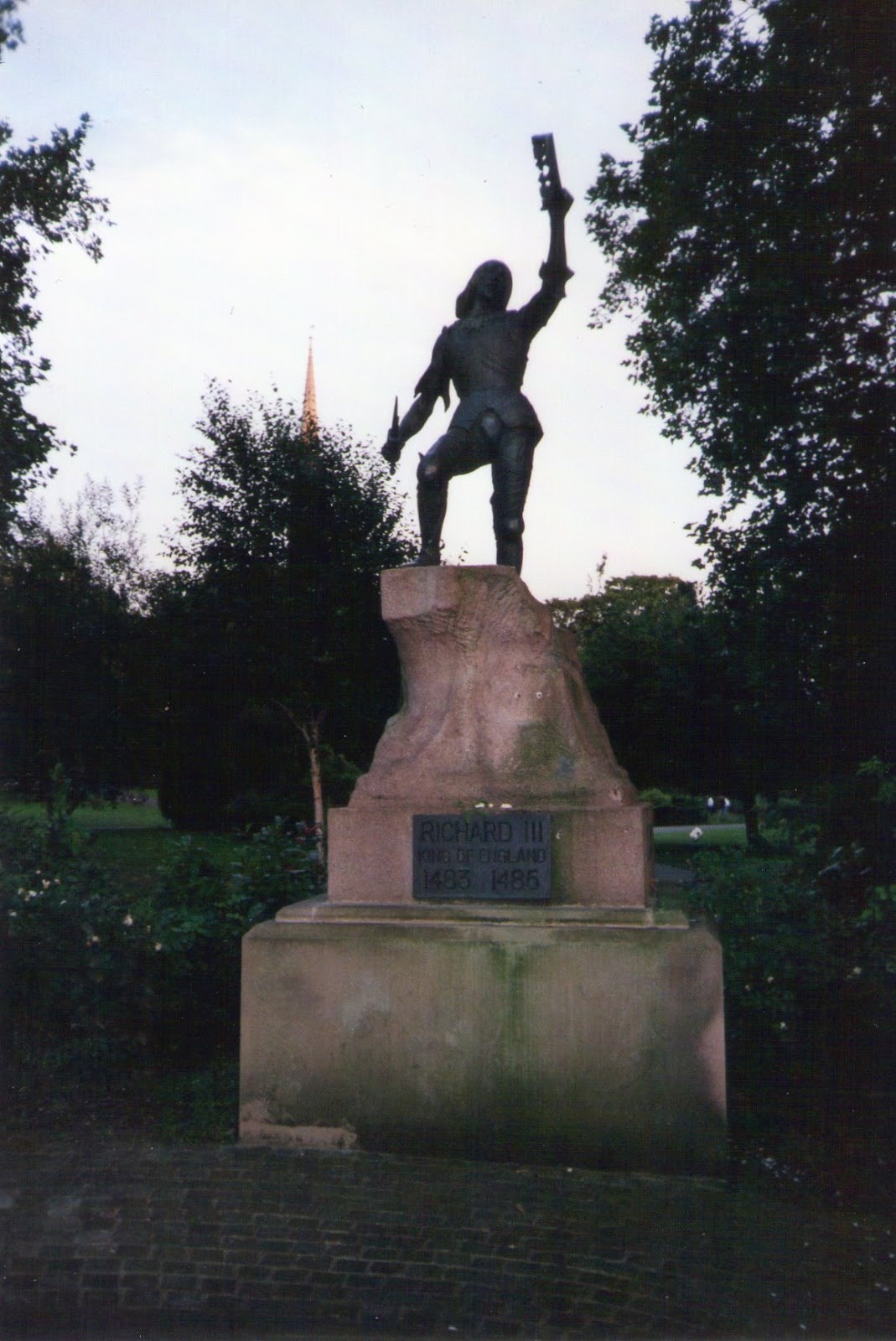
Having said that, the only statue of Richard III is in the city of Leicester, not in York!