Showing posts with label Richard III. Show all posts

Monday, 29 April 2013

York


Founded by the Romans in the 1st century A.D, the city of York has a rich heritage covering every period of history ever since then.
 
In the early Middle Ages, it was the capital of the kingdom of Northumbria, and in the 9th century, it was captured by the Vikings.
 
York Minster, the city’s most well-known edifice, was founded in the 7th century, but the current building dates from the 11th century. It is a beautiful church, and has been completely restored after the disastrous fire in the 1980s. The Rose Window, with its red and white roses, was added at the end of the 15th century  to commemorate the union of the houses of York and Lancaster when Henry Tudor married Elizabeth of York. After the fire, the 7,000 pieces of stained glass had cracked into about 40,000 pieces. Craftsmen took about four years to restore the window to its former glory.
 
It was also interesting to see the memorial window to Richard III, installed by the RIII Society in 1997.
 
The chapel of the medieval Archbishop’s Palace still exists, and it was here that Richard created his son Edward as Prince of Wales in 1483.
 
Substantial remains of the city walls still exist, as do the gates into the city, knows as ‘Bars’. The four main ones were Bootham Bar, Monk Bar, Micklegate Bar and Walmgate Bar. After the battle of Wakefield in 1460, the heads of Richard of York and his son Edmund were displayed on spikes on Micklegate Bar, adorned with paper crowns.
 
In 1472 Edward IV set up the Council of the North, and appointed his brother Richard as its first President. Thus Richard virtually ruled the north on behalf of Edward, and he was highly regarded by the people there, and especially by the City of York. The city archives contain this record, dated 23 August 1485 (the day after the Battle of Bosworth): King Richard, late mercifully reigning upon us … was piteously slain and murdered, to the great heaviness of this city.
 
It seems Richard intended to be buried at York Minster and planned to build a large chantry chapel there for priests to pray for his soul. Definitely a moot point now that his body has been found in Leicester, and plans are underway for him to be buried at Leicester Cathedral. 

Saturday, 27 April 2013

X marks the spot - or does it?


The ‘Bloody Tower’ in the Tower of London is ‘traditionally’ the place where the two princes, Edward and Richard, sons of Edward IV, were reputed to have been murdered by, or on the order of, their ‘wicked’ uncle, Richard III.
 
In the 15th century, it was known as the Garden Tower, because it overlooked the gardens of the Lieutenant’s lodging in the Tower (now called the Queen’s House). It’s worth noting that the Tower at this time was a royal residence, and a contemporary French chronicler mention the boys playing and practising archery in the garden in the summer of 1483.
 
Nothing more was seen or heard of them but this doesn't necessarily mean they had been killed. Reams have been written about them, including the theory that they had been taken elsewhere for safety, possibly in Flanders, but I don’t intend to go into all this now.
 
The first ‘evidence’ came during the reign of Henry VII who defeated and killed Richard at the battle of Bosworth in 1485. One of Richard's knights, Sir James Tyrrell, ‘confessed’ (under torture) that he ) had killed the princes, with the assistance of two others, but was unable to say where their bodies were. However, there is no evidence that Tyrell's alleged co-murderers were ever interrogated, and Tyrell was not charged with regicide.

Thomas More, who gives the most detailed account of the supposed murder, says the bodies were first buried 'at the stayre foot, metely depe in the ground under a great heape of stones' and then moved to a 'better' site 'because thei were a kinges sonnes'. The priest who reburied them had died by this time, and so no one knew where the bodies were buried. How very convenient!
 

In 1674 (i.e. nearly 200 years later) workmen demolishing a stone staircase connecting the royal apartments with the White Tower, found bones in a wooden chest, about “ten feet in the ground”. This has been taken to mean they were found under the stairs, rather than ten feet further down. It was decreed that the bones were those of the two princes, and King Charles II commissioned a marble casket for them which still stands in Westminster Abbey.
 
The whole story seems to have more holes than a sieve! More says the princes were buried at the stair foot, and then moved to a ‘better site’ and the information board at the Tower reiterates this. It says the bodies were buried for 24 hours under the stairway leading to the Wakefield Tower which adjoins the Bloody Tower, and were then removed by a priest and buried under an exterior staircase leading to the White Tower. One wonders how that could possibly be called a ‘better site’? And pity the poor priest who supposedly dug up the bones from under one staircase - and promptly buried them under another! At the time, probably dozens, if not hundreds, of people lived in the Tower of London. So no one saw a priest digging under a couple of staircases and asked questions? Add to that the fact that, if (and this is a big 'if') the princes had been murdered, it would have been far easier to take the bodies through the gate very near the Bloody Tower which led to steps down to the River Thames, from which a boat could take them and dump them out at sea.
 
In 1933, experts were allowed to examine the bones in the casket, but scientific knowledge at that time was scanty at best, and concentrated mainly on dental evidence, much of which has now been discredited.

However, until the royal family allow further examination of the bones, with modern methods of dating etc, there is no way of proving whether or not the bones in the casket are really the bones of the princes. And even if they are, there is still no proof that Richard III killed them. There were others with far greater motives for wanting the princes dead.
The memorial in Westminster Abbey,
supposedly containing the bones of the Princes
 
 
P.S. For true Ricardians, I apologise for this much abridged version of ‘ what happened to the princes?’ I’m well aware it is far more complex than my basic summary here!

Thursday, 25 April 2013

Villains - and one in particular!


The 15th century is not short of villains, but the interpretation of the word depends on whose side you were on. The Lancastrians looked on Richard, duke of York and his sons as villains; the Yorkists considered the weak king Henry VI, and especially his wife Margaret of Anjou as villains. Richard Neville, earl of Warwick, changed sides. So did Lord Hastings and the Duke of Buckingham. Then there was Margaret Beaufort and her son, Henry Tudor.

My top vote, however, goes to the Stanleys.
 
Thomas Stanley, 1st Earl of Derby, (1435-1504) was a landed nobleman in the 15th century who somehow managed to stay on the winning side throughout the Wars of the Roses. Because of his immense power, both sides needed (and sometimes demanded, threatened or begged for) his support.
 
His father held important roles at the court of Henry VI and Stanley’s early loyalty was to the Lancastrian king. However, his marriage to Eleanor Neville, sister of Richard Neville, Earl ofWarwick, brought him into alliance with the Yorkists. In 1459,when his father-in-law, the Earl of Salisbury, was mobilising his forces against the royal forces, Stanley was ordered by the Queen to intercept him, but when the two forces met at Blore Heath in Staffordshire, Stanley kept his 2,000 forces out of the battle.
 
The following year, Stanley openly cooperated with the Yorkists, and joined with his brother-in-law, the Earl of Warwick in his campaigns with the Lancastrians. When Warwick rebelled against Edward IV, Stanley lent him armed support. However, on Edward IV’s defeat of Warwick in 1471, Stanley became a member of the royal council.
 
The death of his wife around this time ended his connection with the Nevilles. His second marriage was to have far greater consequences, as his new wife was Lady Margaret Beaufort, who had previously been married to Edmund Tudor. Her child by this marriage was, of course, Henry Tudor.
 
When Edward IV died unexpectedly in 1483, Stanley was one of the members of the royal council who tried to maintain a balance of power between Richard, Duke of Gloucester and the Woodville family. When Richard denounced the council, Stanley escaped the fate of Lord Hastings who was executed, but he was imprisoned for a time. However, when Richard became king, he found it more advisable to appease rather than alienate the Stanley family. Thus Stanley continued to act as steward of the royal household and bore the mace at Richard’s coronation.
 
He supported Richard in suppressing Buckingham’s revolt in the autumn of 1483, even though  it is highly likely he was actually involved in the conspiracy. Certainly his wife was one of the co-conspirators in the plot to dethrone Richard and put Henry Tudor on the throne. Stanley only escaped attainder by promising Richard that he would keep his wife in custody and end her intrigues.
 
In early 1485, Stanley asked permission to leave the court to attend to his northern estates. Richard was clearly aware of the threat from the Stanley family, and insisted that his son, Lord Strange, remained at court as a token for his father’s loyalty.
 
When Henry Tudor’s forces advanced through Wales in the summer of 1495, Richard ordered Stanley to join him, but Stanley made an excuse, saying he had the sweating sickness. By this time Richard had evidence of Stanley’s treachery since Lord Strange had confessed that his father and uncle William Stanley had conspired with Henry Tudor. Richard sent a message to Stanley saying that Lord Strange’s life depended on Stanley’s loyalty in the coming conflict. Apparently, Stanley’s reply was, “Sire, I have other sons.” Nice father, huh?
 
Stanley and his brother William led their forces south to the Midlands, but they took up a position separate from both Richard’s and Henry Tudor’s forces at Bosworth Field. The general consensus of historians is that he was waiting to see who was the likely winner before showing his hand. Only when Richard led his magnificent charge towards Tudor did the Stanleys act. William led his forces to Henry’s aid, and Richard was surrounded and killed.
 

Legend has it that, when the battle was over, Thomas Stanley discovered the coronet that had fallen from Richard’s head, and placed it on his stepson’s head, no doubt to show that Henry Tudor owed his victory to the Stanleys. Thomas was rewarded with the office of High Constable of England, together with other estates and offices, and was godfather to Henry’s oldest son Arthur in 1486.
 
In the Derby chapel at Ormskirk Church in Lancashire there are effigies thought to be those of Thomas Stanley and his first wife, Eleanor Neville. He was actually buried in the family chapel at nearby Burscough Priory and it is thought the effigies were  brought to Ormskirk Church when the priory was demolished when the monasteries were dissolved in 1536.
 
It’s worth considering for a moment that the treachery of the Stanleys at Bosworth changed the course of English history. Without their intervention, Richard would probably have killed Henry Tudor, thereby securing his throne. There would have been no Tudor dynasty, no Henry VIII, no break with Rome, no Elizabeth I – and maybe Shakespeare would have written a play about the despised Tudor would-be usurper and his traitorous Stanley acolytes!

Wednesday, 24 April 2013

Uncles - good or wicked?


When Edward IV died unexpectedly at the age of forty in 1483, two uncles played a dominant part in the events which followed.
 
The new king, Edward’s twelve year old son, also called Edward, was at Ludlow Castle in Shropshire at the time of his father’s death, under the supervision of his uncle, Anthony, Earl Rivers. Anthony was the brother of Edward IV’s queen, Elizabeth Woodville. After making hurried preparations to travel, he set off for London with the young king, Edward V. At the time, this would have been a journey of several days.
 
The king’s other uncle, Richard of Gloucester, had been named as Lord Protector by Edward IV, which indicated Edward’s trust in Richard to rule the kingdom during the minority of the young king. When Edward died, Richard was at Middleham Castle in Yorkshire. He received information from the Duke of Buckingham that the Woodville family intended to take control of the young king, and of the kingdom.
 
Richard set off south from Yorkshire, intending to meet the royal retinue in the midlands. On April 29th, he met with Buckingham at Northampton, but Anthony Woodville informed them that the king’s party had moved on about twelve miles further south to a small town called Stony Stratford. His excuse was that there were not enough lodging places for both parties in Northampton.
 

Suspecting that the Woodvilles intended to make an early start the next morning to get to London first, Richard acted quickly. Very early the next morning, Anthony Woodville’s lodgings in Northampton were surrounded, and he was arrested. Richard and Buckingham headed straight for Stony Stratford and took the boy kindg into protective custody, so forestalling the attempted coup by the Woodvilles. A small cottage in Stony Stratford, which was once the Rose and Crown Inn, has a plaque commemorating this event.
 
Anthony Woodville and his nephew Richard Grey (the queen’s son by her first marriage) were both executed at Pontefract Castle on 25 June 1483.
 
So, having despatched the young king’s ‘other’ uncle, how did Richard III then become king himself, and earn the epithet of ‘wicked uncle’?
 
Reams have been written about Richard III’s path to the throne. There are those who believe he was consumed with ambition to be king; equally others are adamant that it was forced on him by circumstances. Certainly, after his arrival in London with Edward V, nothing seemed amiss. Plans were made for the young king’s coronation, but at the end of June, it emerged that Edward IV had already been contracted in marriage to Eleanor Butler before he married Elizabeth Woodville. This made his Woodville marriage invalid, and any children of that marriage illegitimate. Thus, it seemed, Edward V could not succeed to the throne, and Richard was next in line.


By J.E.Millais, 1829-96
And what of the ‘Princes in the Tower’? In a previous post, I mentioned James Tyrell who is supposed to have confessed (when being tortured) to murdering the princes on Richard’s orders. Of course, Henry VII had every reason to squash any rumours that the princes were still alive. He’d already had to cope with two ‘pretenders’ posing as Edward V or his younger brother, so what better than to announce they had been murdered by their uncle? This also fulfilled another Tudor need. Henry had basically usurped the throne with no strong ‘royal blood’ claim to it, therefore it suited his agenda to paint his predecessor as black as possible, and reassure his subjects that he had saved the kingdom from this monster who had killed his own nephews.

Did he therefore announce this immediately after Tyrell’s confession? Was Tyrell executed on a charge of regicide? The answer to both is no. Tyrell was executed, but on a much lesser charge of supporting another Yorkist claim to the throne, and it was several years before Henry made public Tyrell’s alleged confession.
 
John Morton and Thomas More, and later Shakespeare (who based his play on Thomas More’s ‘History of Richard III’) perpetuated the myth of the ‘wicked uncle’.
 
Did Richard III have his nephews murdered? The question still remains, and is still argued about by both sides.
 
For more information, the website http://home.cogeco.ca/~richardiii/tyrell.html has a good summary about James Tyrell and the Princes, and I would also recommend ‘The Daughter of Time’ by Josephine Tey. I don’t agree with her on some of her conclusions, as I think she has over-simplified some things, but it’s certainly a very readable introduction to the mystery of the Princes.

Monday, 15 April 2013

Middleham Castle


It’s easy to understand why Richard III loved Middleham, and spent so much time there. Surrounded by the soft green scenery of Wensleydale in Yorkshire, it must have been a calming respite from the upheavals of the war and the court intrigues.
 
Middleham was granted to Alan the Red, eldest son of one of the Norman lords who supported William the Conqueror, and the first castle was built in the 11th century. The present castle was started about a hundred years later, and in 1270 it devolved by marriage to the Neville family. When Richard Neville, earl of Warwick, was killed at the battle of Barnet in 1471, Middleham was forfeited to the Crown, and Edward IV gave it to his brother, Richard, duke of Gloucester.


Gatehouse
Richard had lived at Middleham as a young squire in the household of Richard Neville, and it’s possible that he first met his future wife, Anne Neville, here. The castle became his main base when Edward appointed him Lord of the North in the 1470’s, and his only son Prince Edward was born (and later died) here.
 
The Great Hall (upper floor)
After Richard’s death, Middleham remained in royal hands until the 17th century when it was sold, and gradually fell into disrepair. Nevertheless, the ruins are still very impressive, and also slightly eerie. There are various stories about people hearing faint music from the castle. One group saw a knight on horseback, and a young boy asked his mother if ‘the soldier’ would show him his sword. My ‘spookiest’ moment came at a Medieval Festival at Middleham in 2000, when a re-enactment group performed various imaginary scenes from Richard’s time at the castle. Seeing ‘Richard’ himself striding around the grounds was somewhat surreal. Even stranger, later in the afternoon, was sitting outside a café in the town, chatting to ‘Richard’ and ‘Lord Stanley’!
 
The church in Middleham, dedicated to St Mary and St Akelda, was founded in the 13th century, and enlarged in the 14th. In the 1470s, Richard, as lord of Middleham, petitioned to have the church elevated to a collegiate church, with a dean, six chaplains, four clerk, and six choristers, an honour which the church was allowed to retain even when Henry Tudor usurped the throne.
 
In the 1930s, a memorial window was installed, which shows Richard and his son at one side, and Anne Neville at the other, all kneeling at prayer desks.

Wednesday, 10 April 2013

Investigations into a Skeleton

When Leicester University began its excavations in a city car park last September, they rated their chances of finding the bones of Richard III at less than one percent. Yes, they knew they were excavating in the area where the Greyfriars friary once stood, and yes, there are contemporary records saying that the king, killed at the battle of Bosworth in 1485, had been buried in the chancel of the Greyfriars church, but the search for his bones was akin to the cliché of the needle in the haystack.

However, on the very first day, by an amazing stroke of luck, the first trench opened in the car park revealed a human skeleton. As one of the archaeologists said later, “If we’d decided to dig the trench just fifty centimetres either way, we would have missed it completely."

Of course, this skeleton could have been anyone, but …

Firstly, it was revealed that the skeleton showed signs of battle injuries, especially to the head.

Secondly, the spine was twisted by scoliosis – not the notorious humpback of Shakespeare’s play, but enough to give him one shoulder higher than the other, as reported in contemporary chronicles.

Thirdly, several more trenches uncovered medieval walls, and showed that the area where the bones had been found would have been in the friary church.

For many of us, this evidence was enough to be 99% sure that the bones were those of Richard III. The professional archaeologists and historians, however, were not willing to commit themselves at this stage.

Four months of intensive investigations followed – examination of the bones for injuries and disease, carbon-dating tests, and also DNA analysis.

Examination of the bones showed several injuries, including two severe blows to the head, either of which would have proved fatal. The bones also showed that he had scoliosis, not from birth but from when he was about ten or eleven. The experts said the skeleton revealed a high protein diet of meat and fish, evidence of a rich lifestyle at a time when the ‘ordinary people’ lived mainly on vegetables.

Carbon-dating showed that the bones were from a man who died between 1455 and 1540 (the battle of Bosworth was 1485)


The most conclusive evidence came from DNA analysis. Amazingly, a direct link had been found, via the female line, from Richard’s sister Anne to a Canadian cabinet-maker, now living in London. He agreed to be tested for Mitochondrial DNA, and this was then compared with the DNA from the bones.

It was an exact match, which was why the Leicester University archaeologists were able to announce, at the beginning of February, that ‘beyond reasonable doubt’ the bones were those of Richard III.

The facial reconstruction, based on CT scans of the skull, shows a remarkable similarity to the most famous portrait of the king.

As soon as the announcement had been made, discussions broke out about where Richard III should be buried. Under the terms of the exhumation licence, the decision over the location of the king's reburial rested with the University of Leicester, and so it was announced that he would be buried in Leicester Cathedral, as the nearest 'consecrated place' to where his bones were found. There are those who maintain he should be buried in Westminster Abbey but evidently the Queen, for whatever reason, has ruled out a royal reburial for him there.

An even stronger argument has been made for his reburial in York Minster since it seems this is where he intended to be buried. Yorkshire was his childhood, and some say his spiritual, home, and York never wavered in its loyalty to Richard. On the day after the battle of Bosworth, the York City Council recorded its reaction to the news: King Richard, late mercifully reigning over us, was through great treason . . . piteously slain and murdered, to the great heaviness of this city.

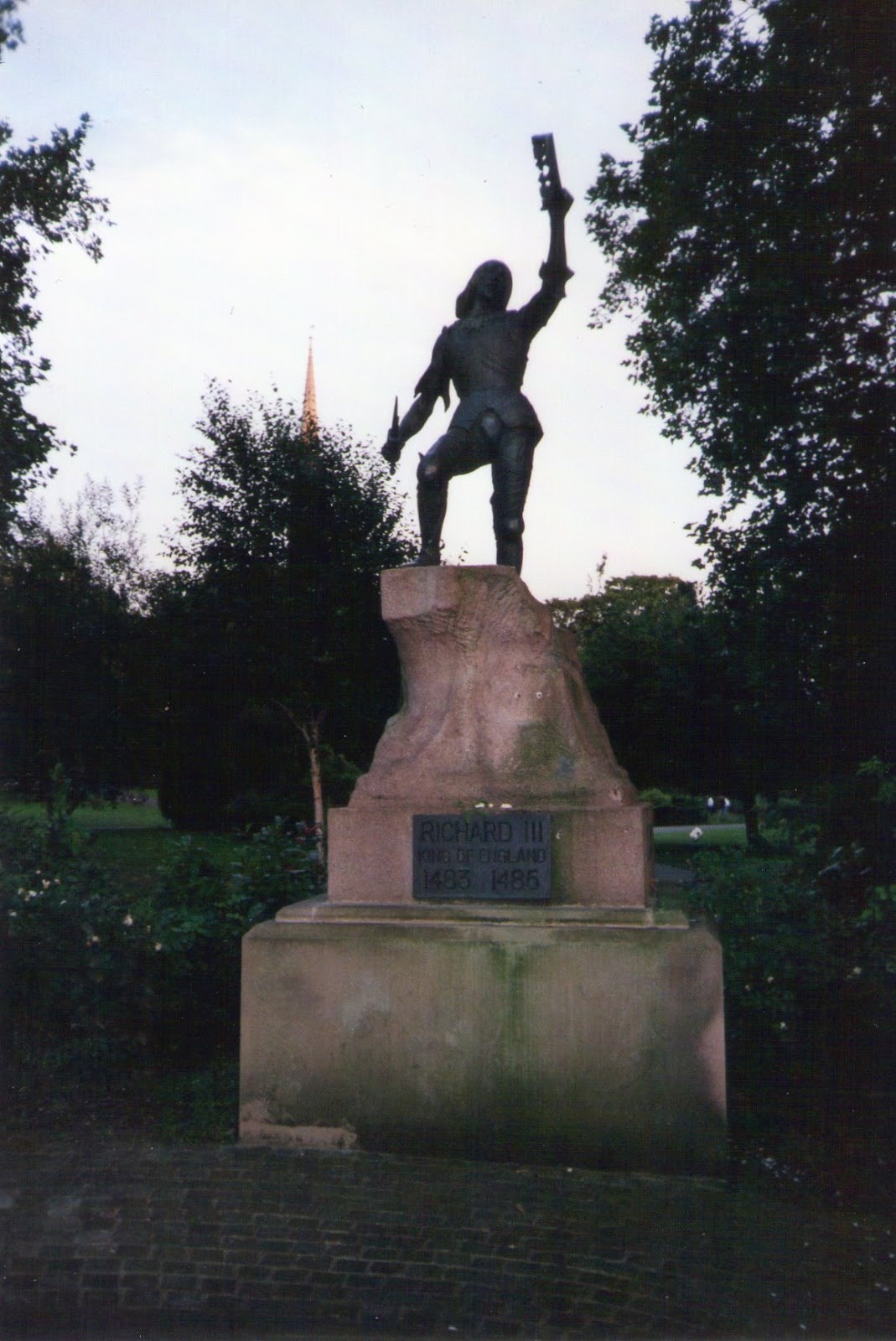
Having said that, the only statue of Richard III is in the city of Leicester, not in York!


Saturday, 6 April 2013

Fotheringhay

The small town of Fotheringhay in Northamptonshire holds a special place in the hearts of all Yorkists because Richard III was born at Fotheringhay Castle on October 2nd, 1452.


The castle was first started about 1100, and had various owners. In the 14th century, Edward III granted it to his fifth son, Edmund Langley, Duke of York from whom the Yorkists descended. Edmund’s son Edward was killed at the battle of Agincourt in 1415, and he was succeeded by his nephew, Richard, Duke of York.


Richard was killed at the Battle of Wakefield in 1460, but it wasn’t until 1476 that his body was brought back to Fotheringhay, to be buried in the church there. The funeral procession was led by his son, Richard of Gloucester (later Richard III), and was met at the entrance of the churchyard by Richard’s older brother, Edward IV.

Edward IV granted the castle and manor to his mother, Cecily Neville, and when she died in 1495, she was buried with her husband in Fotheringhay Church.

The castle was then granted to Cecily’s granddaughter, Elizabeth of York, who had married Henry Tudor, and it remained in royal hands. In 1587, Mary Queen of Scots was beheaded at the castle.

By 1635 the castle had fallen into ruins and was demolished. Traditionally, James I is supposed to have ordered its demolition  to avenge the execution of his mother, but this has no basis in historical fact, as he died in 1625.

Stones from the castle were used for other buildings, and for roads. It’s claimed that the great staircase in the Talbot Inn in nearby Oundle came from the castle.

Nothing now exists apart a fragment of stonework from the great hall, and the motte on which the castle keep once stood. Two plaques commemorate the birth of Richard III and the death of Mary, Queen of Scots.

 
Tomb of Richard, Duke of York,
and his wife, Cecily Neville
Fotheringhay Church is almost a shrine to the Yorkists. As well as the tomb of Richard of York and his wife Cecily, there are various coats of arms around the walls, and a ‘York window’ containing the emblems and shields of the Yorkist family from Edmund Langley to Richard III. Even the kneelers had tapestry covers depicting Yorkist symbols.

And of course there was the 15th century font. In the words of one of the ladies preparing floral arrangements in the church when we visited, ‘That’s where himself was baptised’!

Tuesday, 2 April 2013

Battle of Bosworth

Continuing the A-Z Challenge, the letter B is probably the most well-known battle of the Wars of the Roses
 
The Battle of Bosworth in August 1485 was the culmination (apart from a few later skirmishes) of the Wars of the Roses, when the Lancastrian Henry Tudor defeated and killed Richard III, and claimed the throne.

Tudor’s claim to the throne was tenuous, to say the least. It came through his mother, Margaret Beaufort, who was descended from John of Gaunt and his mistress, Katherine Swynford. Their children, all born illegitimately, were ‘legitimised’ later, but were barred from the succession. Nevertheless, the Lancastrians looked to Henry Tudor as the ‘rightful heir’, as did some disaffected Yorkists such as the Duke of Buckingham.

Tudor, after many years of exile in France, landed in Wales on August 7th with about 2,000 men. With no battle experience, he relied on his commanders, but his hopes of the Welsh flocking to his cause were disappointed. His force numbered about 5,000 as he marched across Wales and England to meet Richard’s army.


Richard had been aware since June of Henry’s impending invasion, and his forces (about 10,000 men) convened at Leicester, and then proceeded westward to Sutton Cheney, and a low ridge called Ambion Hill, about 12 miles west of Leicester.

The result of the battle, on August 22, should have been a foregone conclusion, considering the strength of Richard’s forces. However, one man held the key to Richard’s victory or defeat – Thomas Stanley. Well-known for changing allegiance during the wars, depending on which side was likely to win at any given time, Stanley played the same game at Bosworth, and held back his force of about 5-7,000 men.

There are differences in the accounts of what happened after the battle (mainly hand-to-hand combat) had been in progress for some time. One view is that Tudor, facing defeat, headed in the direction of Stanley’s forces to persuade them to enter the battle on his side. Another view is that the Stanley forces began to advance to side with Tudor.

Richard then led what was to be the last great cavalry charge of the medieval era, and thundered down directly towards Tudor himself, intending to kill him before the Stanley forces could enter the battle and change its course. In the ensuing melee, Richard was unhorsed, but continued fighting on foot until he was surrounded by Stanley’s men and killed.

The death of the king signalled the end of the battle, and Richard’s forces disintegrated.

Tradition says that Richard’s crown was retrieved from a hawthorn bush by Thomas Stanley (boo! hiss! I make no apologies for my allegiance to Richard III), who then placed it on Tudor’s head.


The actual site of the battle has been disputed by historians, but Leicester County Council has built an excellent battlefield centre near Ambion Hill, and laid out a sign-marked route around the battlefield. I will never forget my first sight of Richard’s standard flying on Ambion Hill!

This stone marks the traditional site of where Richard was killed. However, since I took this photo in 1999, this site has been disputed, and the stone has now been moved to the Battlefield Centre.

Sunday, 24 July 2011

My First 'Adult' Book


It’s the first Blogfest at “Heroines with Hearts”, the group blog to which I belong with four other writers.  The blogfest is to celebrate getting 100 followers, although we’ve now increased that to 111 – you can follow us at http://heroineswithhearts.blogspot.com and join in our discussions on a different writing topic each week, usually posted on Mondays.

The ‘rule’ for this blogfest is simple:  “All you have to do for this blogfest is fess up on the first adult book you picked up and read: whether a classic, a racy novel or that of unusual content, then post your entry on own blog July 24th/25th.”  Click here to read what other people have chosen as theit first adult book.

Actually this topic got me thinking.  My teacher in my final year at junior school introduced us to some of the classics, though only in bite-size pieces – selections from Jane Eyre, Wuthering Heights, Kenilworth, Treasure Island.  In high school, I seem to recall David Copperfield being the first set book in our English Literature classes.


But what was the first adult book I actually chose to read?  As I thought more about this, the fog cleared and I remembered.  Well, it might not have been the first, but it was a book which had a profound effect on me – ‘The Daughter of Time’ by Josephine Tey. 


Alan Grant, a police inspector, is trapped in hospital with a broken leg and is bored out of his mind.  He considers himself an expert on faces so his friend gives him some portraits to study.  He decides one face is that of a man of conscience and integrity who has suffered, and is then shocked to discover that he is looking at a portrait of King Richard III, the ‘monster’ said to have murdered his nephews to gain the crown of England.

The rest of the book is Inspector Grant’s ‘investigation’ of the murder of the ‘Princes in the Tower’, similar to a modern investigation, but using 15th and 16th century ‘witnesses’ in different historical sources.  In the end, he comes to his own conclusions about the unreliability and/or prejudice of many of these witnesses, and forms his own opinion about the real villain.

Josephine Tey brought the controversy surrounding Richard III and the Princes in the Tower to a wide public audience in the 1950’s and is perhaps the most popular defense of Richard ever written.  Forget the fact that it is unbalanced and ignores the evidence against Richard, forget the fact that dozens more books have since been written which have examined all aspects of evidence. 

This book has inspired people all over the world to question the traditional (i.e. Shakespearean) view of Richard III as an evil, crookback murderer.  Ask any ‘supporter’ of Richard III what first got them interested and 9 out of 10 will probably say ‘The Daughter of Time’.

It has had a lasting effect on me, probably more than any other book I’ve ever read.  I won’t say it was this book which inspired me to become an historian, as I was already more interested in history than in any other subject.  But my interest in Richard III still continues, more than 50 years since I first read the book.  I now have a whole shelf of other books written about Richard and the Wars of the Roses, not least Sharon Kay Penman’s wonderful novel ‘The Sunne in Splendor’, and I've visited many places linked to the later 15th century, including Richard's own castle at Middleham in North Yorkshire.